Technical Paper · Control Tower · £7
Run several streams of real work from one always-on AI — and build it from zero.
You already know the drag: one AI chat, one job, and you sitting there babysitting it. Open another for the next task and you’re the bottleneck again. This paper hands you a different shape entirely: one orchestrator that never sleeps, several lanes running at once, a shared brain they all read, and a sign-off gate so nothing ships without you. The architecture, the steps from nothing, the exact things to ask your AI at each stage, and the boot-layer rules that make it start the same way every single time.
The promise
Stop running one chat at a time. Run a control tower, and I’ll show you how to build one from zero.
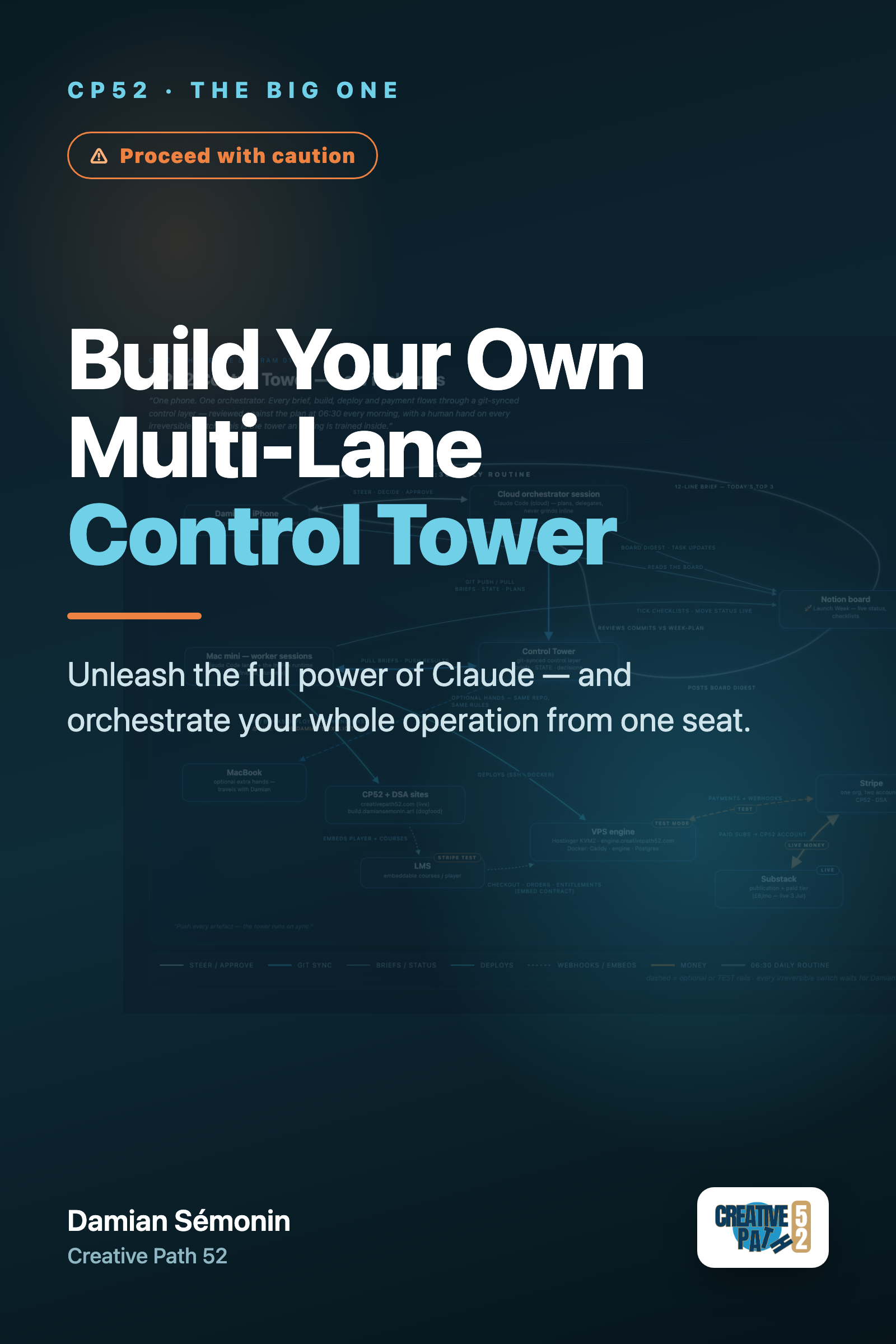
Thirty-one pages that take you from “I open a new chat for everything” to one always-on orchestrator fanning work out to parallel lanes and pulling it back for your sign-off. Not theory, and not a copy of my private machine either: the map and the method, at the level of principle and shape, so you can build your own. You don’t need to be a developer. You need a Mac you can leave on, a phone, a git account, and a willingness to write a few plain-text rules. One thing to do on this page: put your name down.
Get the paper · £7 →£7 · a downloadable PDF (31 pages) · written from a working setup, not a whiteboard.
Why trust the person writing this
This isn’t a diagram I dreamed up; it’s the setup I run my own launch on.
The Control Tower is the working pattern behind steering a whole launch week from a single point. Written from real use. The receipts behind the name:
What's inside the paper
The whole shape of the thing (model, build, guardrails, coordination, plan), so you finish it able to build one, not just admire one.
One always-on orchestrator
The single steering brain that never closes. You brief it once and steer from your phone, instead of reopening a fresh chat for every job.
Parallel lanes
Several streams of real work running at once, fanned out and pulled back, instead of you queuing tasks single-file behind one busy assistant.
Boot-layer guardrails
The plain-text rules that make it boot the same way, every time. That is the difference between a reliable machine and a clever demo that drifts.
Build from zero
Chronological steps and the exact things to ask your AI at each stage, so there's no guesswork about what to type, in what order, to stand it up.
A one-week build plan
A realistic day-by-day path to a working tower, so it stays a thing you actually finish rather than a project that sits half-built forever.
The offer
Everything you need to build one, for less than a round of coffees
One paper, 31 pages, no filler. Here’s exactly what’s in it.
- The architectureOrchestrator, lanes, shared brain, sign-off gate: the whole shape on one map Included
- The build, step by stepChronological steps from zero, plus the exact asks to make at each one Included
- The boot-layer guardrailsThe plain-text rules that make it start the same way, every time Included
- How the lanes coordinateHow parallel streams share state without stepping on each other Included
- A one-week build planA realistic path from nothing to a working tower in seven days Included
Building the whole toolkit? This is one of seven technical papers: grab any six for £15, or all seven for £19.
Written from a live launch, and kept current. This is the pattern I’m running right now, so it’s drawn from real use, not frozen theory. Buy it today and the link is in your inbox a moment later. No fake countdown, just a genuine head start.
If it isn’t genuinely useful, ask and I’ll refund it.
It’s £7, and I’d rather you kept your trust than my seven quid. If you read it and it doesn’t earn its place — if it doesn’t give you a real, buildable path — email me and I’ll refund it, no interrogation. And I’ll be straight about the line: where this touches my own runtime it stays at principle and shape, so you get the map and the method, not my private internals. You’re buying a way of working you can build yourself.
Fair questions
Do I need to be able to code?
No. It’s plain-text rules and asking your AI the right things in the right order. You need a Mac you can leave switched on, a phone to steer it, a git account, and a willingness to write a few instructions in plain English. The paper tells you exactly what to ask.
What hardware and accounts does it assume?
A Mac you can leave running, your phone as the steering point, and a git account for the shared brain and sync. Nothing exotic; the point is that this runs on kit you likely already have.
Is this just InkFox, my private runtime, repackaged?
No. It teaches the Control Tower method generally: the shape and the principles anyone can build. Where it brushes against my own runtime it stays at the level of map and method; the private internals stay private. You’re getting the blueprint, not a copy of my machine.
What exactly do I get, and in what format?
A downloadable PDF, 31 pages: the architecture, the build-from-zero steps with the exact asks, the boot-layer guardrails, how the lanes coordinate, and a one-week build plan.
How do I buy it?
It’s £7. Click the button, pay by card, and the download link is emailed to you the moment the payment settles — a signed link that is yours alone and good for seven days.
Is there a bundle if I want more than one paper?
Yes. This is one of seven technical papers. Any six are £15, and all seven are £19 — £6 off the £25 the seven cost singly, and the best value if you’re building the whole toolkit rather than dipping into one piece.
£7 · buy it now
Trade the one-chat-at-a-time grind for a tower that runs several lanes at once.
Buy it now and the download link lands in your inbox. Thirty-one pages: the architecture, the build-from-zero steps, the exact asks, the boot-layer guardrails, and a one-week plan. It's the same setup I run my own launch on.