There's something about being out in weather that strips everything back to what actually matters.
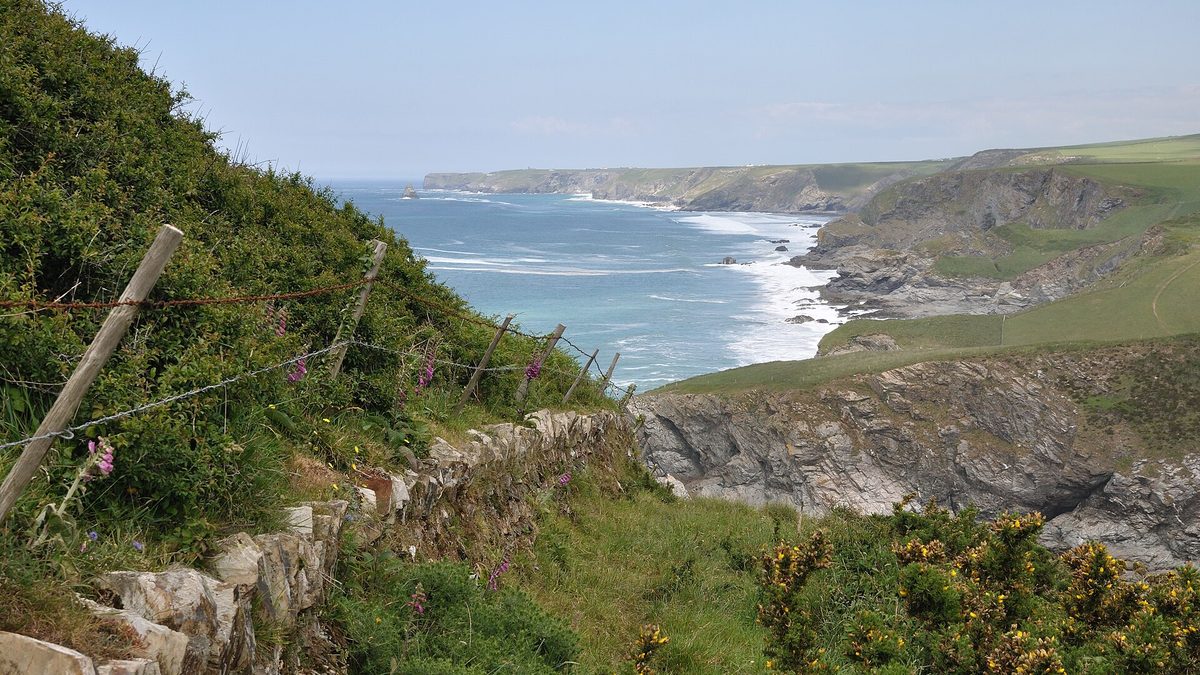
February 6th. I'm out early — earlier than usual, because of some scheduling thing that meant the normal window had shifted. The light is different at this hour. Lower. Softer in a way that winter light gets when the sun is still not fully committed to the day. It's been raining on and off since about 4am and the coastal path is that particular shade of dark that wet granite turns when it's had a proper soaking.
I have my phone in my pocket and my hood up and I am, by most reasonable definitions, talking to myself.
This is my morning practice. Seven kilometres, most mornings. Voice memos into my phone. Whatever's in my head that morning: ideas for the course I'm building, problems I've been chewing on, things I've been reading, observations about how things are going. The whole slightly chaotic stream of it, walking and talking into a microphone while Cornwall does what Cornwall does, which is mostly be beautiful and wet.
I want to tell you why this works, because I think it's more than just "exercise is good for creativity" — though it is, and I'll get to that.
When you're walking in weather, you have to commit. You can't half-do it. You can't sit at a desk and drift to your phone or get up for a third coffee. You're out there, the wind is doing what it wants with your hood, the path is getting your boots muddy, and you're just... present with your thoughts in a way that's hard to manufacture in any other situation.
There are no competing inputs. The environment is demanding just enough of your attention (watch the path, feel the weather, keep moving) that the background noise of admin and worry and to-do lists falls away. What's left is whatever is actually live in your thinking.
That's when the real stuff surfaces.
I started doing this because of time boundaries, actually. There was a period (parents, transitions, the general upheaval of a life restructuring itself) when I was trying to figure out when I could actually think. Not work. Not tick boxes. But think. Properly.
The mornings became that. Before the day got noisy. Before the emails and the decisions and the students and the 47 tabs that always seem to be open in my brain as well as on my computer.
The walking cleared space. And the recording meant I didn't lose what came into that space.
That second part matters more than people realise. We've all had the experience of thinking something important during a run or a drive or a shower, and then losing it completely by the time we're in a position to write it down. The thought was real. It was there. But your brain, which doesn't distinguish between "I need to remember this" and "I need to remember where I parked," filed it somewhere inaccessible and moved on.
The voice memo is the insurance policy against that loss. You catch the thought in the moment it arrives, before the next thing has time to push it out.
What I've noticed, after doing this for a while now, is that the walking and the recording together create something more than the sum of their parts.
Walking has a rhythm. Your breathing settles into it. Your thinking starts to follow the same cadence: not urgent, not spinning, but moving forward at a pace that feels workable. You start to connect things that don't normally get connected. A book you've been reading brushes up against a problem you've been stuck on, and suddenly there's something useful happening.
The recording means you can follow that thread. You don't have to hold it in your head while simultaneously trying to develop it. You say the thought, it's captured, and then you can take the next step from it rather than circling back to secure the first one.
It's a different mode of thinking than the desk-and-screen version. Not better for everything: I still need to sit down for focused drafting, for the detail work. But for the generative thinking, the ideation, the working out what I actually want to say before I work out how to say it — the walk is better every time.
The Cornwall setting isn't incidental, by the way. I'm not just romanticising it.
There is something specific about landscape that recalibrates your sense of scale. When you're on a coastal path and the sea is out there doing its enormous slow thing regardless of whether you exist or not, your problems adjust themselves accordingly. Not in a "nothing matters" way: I'm not advocating existential nihilism as a productivity hack. More that the urgent things become their actual size rather than the inflated size they seem at a desk.
The creative problem you've been wrestling with for three days. The decision you've been circling without landing. They don't go away on a cliff path in February, but they become workable. The space around them opens up.
I think there's a version of this available to everyone, regardless of where they live. Not everyone has a coastal path. But most people have somewhere they can walk that isn't a screen or a meeting room or a kitchen full of the usual associations.
The principle is simple: movement plus capture. Walk somewhere that requires just enough physical attention to quiet the noise. Record what surfaces. Don't worry about whether it's good: it almost certainly won't be at first, and that's completely fine. The point isn't the quality of the individual recording. The point is the habit of externalisation. Getting your thinking out of your head and into the world in some form, before the day closes in and takes the space you'd found.
All of this content — these posts, this whole project — started on a morning walk in Cornwall. Talking to myself in the rain.
It's worked out okay so far.
Try it this week. Set out somewhere you can walk for 20 minutes without stopping. Take your phone. When a thought arrives, record it. Don't try to be coherent. Just catch it. Come back and listen to what you said. You might be surprised what was in there.
CP52 Stage: Stage 4 · The Work (doing the creative work daily)
Series: Morning Walk Dispatches
Image note: A coastal path in drizzle. Hood up, mud on boots. The beautiful grey of a February morning in Cornwall.
Cover photo: “Coast path” by Dietrich Krieger, CC BY-SA 3.0.